Why Buy a New Shipping Container from Inspect-Home.com?
New, first-use containers • Inspection • On-site delivery • Reliable service • Dealer opportunities
Shipping containers are no longer used only to move cargo from one port to another. They have become practical tools for homeowners, contractors, farmers, retailers, manufacturers, logistics companies, schools, churches, emergency-response organizations, and businesses that need secure space without constructing a permanent building.
As the market has expanded, so has the number of choices. Buyers can find used containers, wind-and-water-tight containers, cargo-worthy containers, one-trip containers, refurbished units, and specialty equipment. A lower advertised price can be attractive, but the real question is: what are you actually receiving for your money?
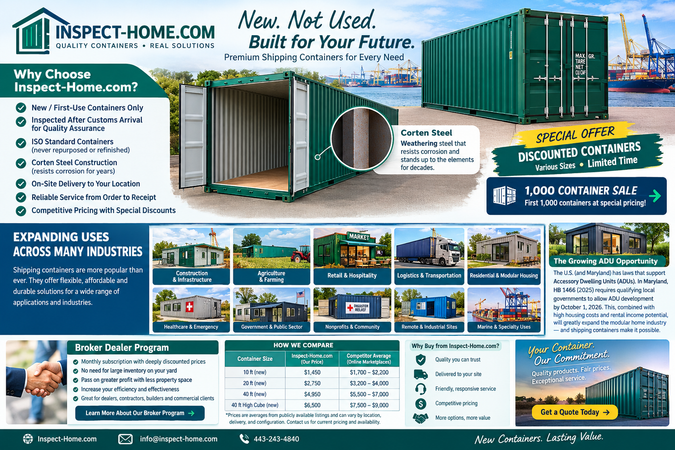
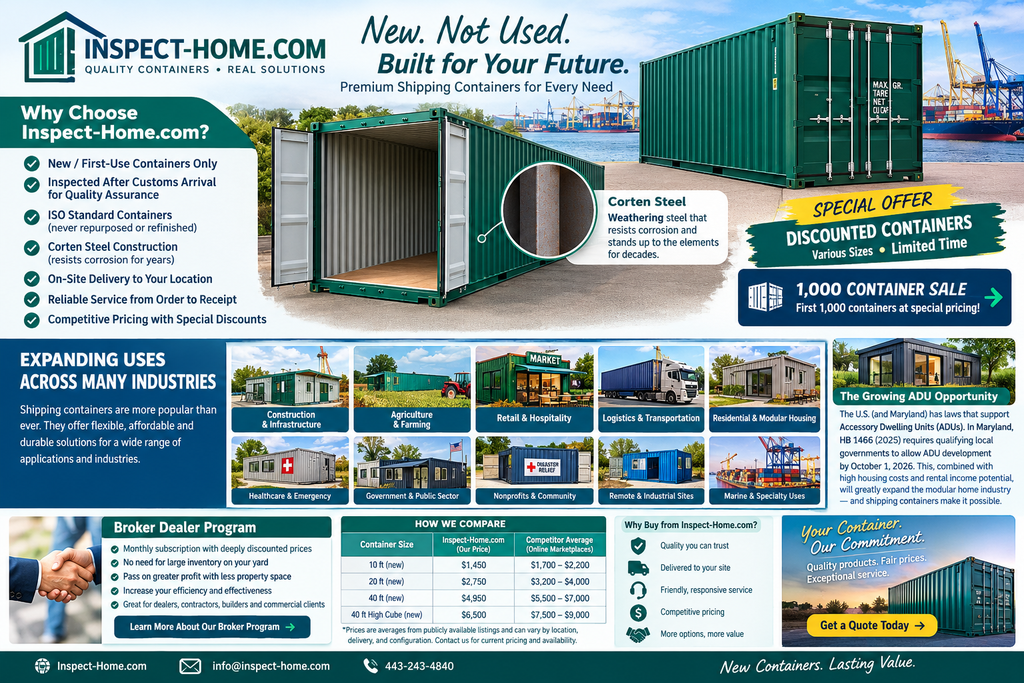
Inspect-Home.com is built around a straightforward idea: give customers a high-quality container sourced as a new, first-use product rather than a repurposed or refinished used box. The company’s current sales strategy is focused on new/first-use shipping containers in multiple sizes and configurations, with inspection and delivery support built into the customer experience.
That difference matters. If you expect to keep a container for many years, protect valuable equipment, modify it into a building, or resell it to another customer, starting with a new container can provide a different value proposition than buying a previously used box.
Shipping Containers Are Becoming a Solution Across Many Industries
- Construction and contracting: job-site storage, tools, materials, temporary offices and project staging.
- Agriculture and farming: equipment, feed, supplies, seasonal inventory and tools.
- Retail and small business: pop-up stores, inventory storage, mobile sales spaces and future modular projects.
- Warehousing and logistics: overflow storage, micro-distribution, inventory protection and temporary capacity.
- Residential property: household storage, workshops, hobby rooms and permitted conversion projects.
- Modular construction: homes, offices, studios, classrooms, medical spaces and other engineered applications.
- Government, nonprofit, church and community use: records, supplies, disaster-response equipment and temporary storage.
- Recreation and specialty uses: workshops, hunting/outdoor storage, event spaces and equipment rooms.
Industry sources likewise describe containers being used for construction, agriculture, onsite storage, modular building, retail and residential projects. The attraction is practical: a standardized steel structure can be delivered where secure space is needed and then used as-is or incorporated into a properly designed project.
Reason #1: Inspect-Home Focuses on New, First-Use Containers
One of the central differences in the Inspect-Home model is its focus on new or first-time-use shipping containers. The customer is not simply being offered a used container that has been returned to service, patched, repaired, repainted or refinished.
A new, first-use container begins its life at the manufacturing source. That gives the buyer a different starting point from a container that has already spent years in international service.
This does not mean every used container is a bad container. Used containers can be economical and can work very well for many storage applications. But condition varies, and buyers have to understand the grade and history of what they are purchasing. A new/first-use container provides customers who value condition and appearance with a more consistent starting point.
For customers planning to modify a container into a workshop, office, retail structure, modular building component or residential project, beginning with a new container can also be attractive because the customer is not starting with an unknown repair history.
Reason #2: Corten Steel and the Advantage of a Purpose-Built Container
Inspect-Home’s new containers are built from Corten weathering steel, the material commonly associated with intermodal shipping containers. Weathering steel is designed to form a protective surface layer that can slow further corrosion under suitable conditions.
That does not mean a Corten-steel container is corrosion-proof. Location, salt exposure, standing water, damaged coatings, ventilation, drainage and maintenance all affect service life. A responsible buyer should prepare a level site, keep water from pooling beneath the container and inspect the unit periodically.
The important point is that Inspect-Home starts with a purpose-built container rather than asking the customer to accept a container whose history and repairs may be unknown.
Reason #3: Inspect-Home Adds an Inspection Step Before Delivery
Buying a container online is different from buying a small package. A 20-foot or 40-foot container is a major piece of equipment, and delivery involves freight, unloading, property access and placement.
Inspect-Home’s customer-service approach includes inspecting the container after arrival from customs before arranging delivery to the customer. The goal is simple: identify quality issues before the container reaches the customer’s property, rather than discovering a problem after a truck has arrived.
That is a customer-first idea. Nobody wants to prepare a site, schedule equipment, arrange workers and then discover an unexpected problem when the container arrives.
Inspection should not be interpreted as a promise that no manufacturing or transportation issue can ever occur. It is an additional quality-control step intended to improve the delivery experience and provide a more reliable handoff.
Reason #4: On-Site Delivery Means the Purchase Includes More Than the Steel Box
A container only becomes useful when it reaches the customer’s property. Inspect-Home offers on-site delivery, allowing the customer to plan around the actual destination rather than treating pickup as the end of the transaction.
Before ordering, confirm truck access, turning space, overhead clearance, site conditions, unloading requirements and local restrictions. Delivery pricing can vary by distance, location, equipment and market conditions.
The best container price is therefore not always the lowest container-only price. Buyers should compare the complete delivered transaction: container, freight, unloading, placement requirements, condition and customer support.
Reason #5: A Reliable Process From Order to Receipt
For many first-time buyers, the hardest part is not choosing between 20 feet and 40 feet. It is knowing what happens after clicking buy. Who confirms the order? Where is the container? Has it cleared customs? Who checks it? When will it be delivered? What should the property owner prepare?
Inspect-Home is designed around a more guided process: select the container, confirm order and delivery details, receive it through the supply chain, inspect it after customs arrival and coordinate delivery to the customer’s location.
That emphasis on communication matters because a container purchase is a physical logistics transaction. The customer’s experience should not end with a payment confirmation.
Reason #6: Competitive Pricing Without Giving Up the New-Container Strategy
Inspect-Home is pursuing a low-price strategy while maintaining a new/first-use product focus. The company is also offering discounted container opportunities in multiple sizes. Because freight, port costs, inventory and regional delivery can change, buyers should use the live product page for the current price rather than relying on a permanent advertised number.
Boxhub currently publicly lists new 20-foot containers from about $2,700 and new 40-foot containers from about $4,500, alongside lower-priced used units. These are advertised starting prices and can vary by market and delivery.
Western Container Sales currently publishes Maryland sample pricing that illustrates why condition matters. Its Baltimore table lists a 20-foot wind-and-water-tight unit at $845, a cargo-worthy unit at $1,245 and a one-trip unit at $2,290; its 40-foot high-cube examples are $1,490, $1,890 and $3,045 respectively. The company notes that delivery is not included.
These figures are not an apples-to-apples quote comparison with Inspect-Home. They demonstrate the buyer’s real decision: a lower used-container price can represent a different condition and history than a new/first-use container. Always compare exact size, grade, specifications, delivery and terms.
For Inspect-Home customers, the current discounted offerings and first-1,000-container launch promotion make the new-container proposition particularly worth checking. Promotion terms and inventory should be confirmed before purchase.
Reason #7: The First 1,000 Containers Create a Limited Launch Opportunity
Inspect-Home has created a special launch promotion for the first 1,000 containers sold. The stated concept is to extend launch/broker-rate pricing to early customers while the promotion lasts.
If you are going to buy a container anyway, compare the current Inspect-Home launch price with the complete delivered cost of other sellers. The promotion should be treated as time- and inventory-sensitive, so customers should review the current promotion page for applicable size, price, availability and delivery terms.
Reason #8: A Broker Dealer Program Designed Around Recurring Sales
The opportunity becomes especially interesting for dealers, contractors, builders, brokers, storage operators and businesses that sell or consume containers repeatedly.
Inspect-Home’s Broker Dealer Program is designed to support recurring volume rather than forcing a dealer to purchase a huge inventory and fill a yard before customers exist.
The program can be structured around monthly subscription-style purchasing, with deeply discounted volume pricing for qualified customers and larger recurring quantities. It specifically contemplates customers needing 25 or more containers per month, subject to quotation and supply arrangements.
Think about what that can mean for a dealer. Instead of spending capital on a large inventory, paying for yard space, moving containers repeatedly and waiting for inventory to sell, a dealer can explore a recurring supply relationship. The dealer can focus on finding customers and selling containers while supply is scheduled around demand.
This can potentially improve space utilization, reduce inventory carrying pressure and leave more room for sales. It can also give dealers an opportunity to offer new/first-use products rather than competing solely on used-container price.
Actual economics depend on sales price, delivery costs, financing, taxes, local market, order volume and negotiated supplier pricing. The model nevertheless deserves consideration for anyone selling containers regularly.
A Growing Opportunity: Containers and the Modular/ADU Market
One of the most interesting long-term applications is modular housing and accessory dwelling units, commonly called ADUs.
ADUs are independent smaller living units that can be attached to or detached from a primary single-family home. They can serve family members, aging relatives, guests or rental purposes where local law permits.
The regulatory environment is evolving. In Maryland, the General Assembly passed HB 1466 in 2025. The Maryland Department of Planning says the law establishes a state policy supporting ADU development and requires counties and municipalities with planning and zoning authority to adopt local laws authorizing ADU development on qualifying single-family properties by October 1, 2026.
This is important, but it should not be misunderstood as a nationwide rule automatically permitting a shipping-container home in every backyard. ADU requirements remain dependent on state and local law, zoning, building codes, permits, utilities, setbacks, fire requirements and site conditions.
For the container industry, expanding ADU policy creates an opportunity for properly designed modular products. High housing costs, limited housing supply and the possibility of rental income are among the reasons property owners are exploring ADUs. A new shipping container can serve as one potential structural starting point for a professionally engineered and code-compliant modular project.
The key word is potential. A shipping container does not automatically become a legal dwelling simply because it is placed in a backyard. Anyone pursuing a container-based ADU should consult local building and zoning authorities and qualified design professionals before purchasing or modifying a container.
Why New Matters Even More When You Plan to Modify the Container
If a container is only being used for basic storage, a used unit may be perfectly adequate for some buyers. But when a customer plans to cut openings, install windows and doors, add insulation, run electrical systems, install plumbing or create a finished modular structure, starting with a clean new container can be appealing.
The customer is investing in modifications. Once the build-out begins, the container itself becomes one part of a much larger project. Starting with a new/first-use shell can make the initial condition an important part of the project decision.
A Simple Buyer Checklist
- Choose the size: 10, 20, 30 or 40 feet.
- Choose standard or high-cube height when available.
- Choose access: standard, double-door, side access or specialty configuration.
- Confirm new/first-use status and exactly what that means in the seller’s terms.
- Confirm material and condition specifications.
- Ask how the container is inspected before final delivery.
- Get the complete delivered price, not just container price.
- Prepare a level, stable site that prevents standing water.
- Confirm truck access and unloading requirements.
- Check zoning, permits and local rules if the container will be modified or used as a structure.
The Bottom Line: High Quality, Standard, With Customer Service
At the end of the day, buying a shipping container is about more than buying steel. You are buying protection for equipment, space for a business, an asset for a property or a building component for a future project.
Inspect-Home’s approach is built around three ideas: high quality, standardized new/first-use containers and customer service.
The company emphasizes new/first-use containers rather than a mixed inventory of used and refurbished boxes. It offers inspection after customs arrival, on-site delivery, current discounted container opportunities and a recurring broker-dealer program for businesses that need volume.
It also recognizes that price matters. That is why Inspect-Home is pursuing competitive pricing and special launch discounts rather than asking customers to pay a premium simply because the product is new.
If you are a homeowner, contractor, farmer, business owner, storage operator, builder or dealer, compare the exact product, condition, delivered cost and service. Then decide which supplier provides the value you need.
If Inspect-Home can give you a new/first-use container, inspected before delivery, delivered to your site, supported through the order process and priced competitively with the market, it deserves a place on your comparison list.
So why not take a closer look? Start with the container you need. Review the current size and configuration. Check the promotional pricing. If you are a dealer or recurring buyer, ask about the monthly Broker Dealer Program. Before ordering, make sure the complete delivered transaction fits your budget and site.
Inspect-Home.com is not simply selling a steel box. The goal is to make buying a new shipping container a more dependable, understandable and customer-focused experience—from the manufacturing source to your property.